
.svg)
Tax competitiveness, European Union membership and quality of life continue to position Cyprus as an attractive base for international investors and high-net-worth families.
Cyprus continues to strengthen its profile in the global competition for internationally mobile wealth. According to Henley & Partners’ Private Wealth Migration Report 2026, published in June 2026, the island achieved a Wealth Mobility Competitiveness Score of 73.5 out of 100, placing fourth globally and among Europe’s leading jurisdictions in the report’s overall ranking (Henley & Partners, 2026).
The findings reflect a broader trend: internationally mobile entrepreneurs, investors and affluent families are increasingly evaluating destinations not only on the basis of taxation, but also on legal certainty, residence options, business opportunities, geopolitical stability and quality of life.
For Cyprus, these advantages are reinforced by its membership in the European Union, its strategic location between Europe, the Middle East and Africa, and an established professional services sector supporting international business, investment and relocation.
What Makes Cyprus Attractive to International Investors?
Cyprus offers a combination of financial, practical and lifestyle advantages that can appeal to individuals seeking a European base for their personal and business interests.
Its tax framework, international business environment and established network of professional advisers provide a foundation for cross-border operations and long-term financial planning. The island also offers access to European markets, a Mediterranean climate and a range of residential and commercial property opportunities.
Residence and tax residency are particularly important considerations for internationally mobile families. Cyprus provides both the 183-day and qualifying 60-day tax residency routes, subject to the applicable statutory conditions. Eligible non-domiciled tax residents may also benefit from exemptions from Special Defense Contribution on qualifying dividend and interest income, subject to the relevant legislation.
The country’s tax framework has continued to evolve. Comprehensive tax reforms took effect on 1 January 2026, introducing changes to personal income tax, corporate taxation and other areas. The reforms also introduced a mechanism allowing certain eligible individuals to extend their non-domiciled status for up to two additional five-year periods, subject to specific conditions and an upfront payment of €250,000 for each five-year period (KPMG, 2026; KPMG Cyprus, 2026).
These developments make individualized tax planning increasingly important. The suitability of Cyprus depends on each investor’s circumstances, including nationality, existing tax residence, income sources, business structure and long-term objectives.
A Changing Global Landscape for Wealth Mobility
Henley & Partners’ 2026 report highlights a broader shift in how wealthy individuals approach international mobility. Rather than necessarily relocating all their personal and financial interests to a single country, many are exploring a wider range of residence rights, business locations and investment opportunities across multiple jurisdictions.
The report’s Global Wealth Mobility Framework assesses 12 dimensions through 38 weighted indicators, including taxation, the rule of law, quality of life, investor access, family inclusion, geopolitical stability and capital mobility. Its findings draw on data from international organisations, including the World Bank, the International Monetary Fund and the OECD, alongside Henley & Partners’ own market intelligence (Henley & Partners, 2026).
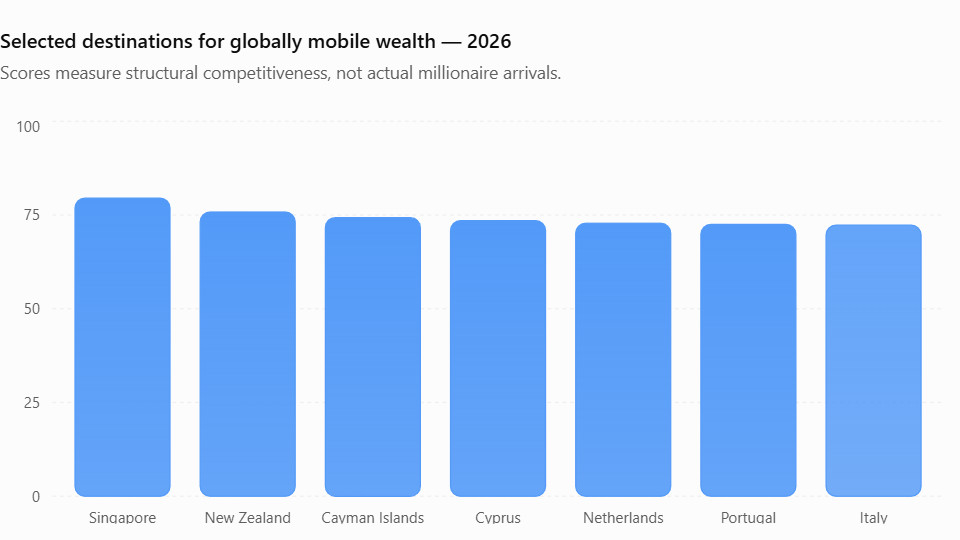
Singapore recorded a score of 79.5, followed by New Zealand at 75.8 and the Cayman Islands at 74.3. Cyprus scored 73.5, ahead of the Netherlands at 72.8, Portugal at 72.5 and Italy at 72.3.
The findings have also attracted wider media attention. Euronews’ coverage of the report highlighted the growing competitiveness of certain European destinations and the importance of examining the factors that influence international wealth mobility (Euronews, 2026).
It is important to distinguish this year’s ranking from the 2025 millionaire migration estimates. In 2025, Cyprus ranked 17th, with an estimated 250 millionaires relocating to the island and bringing approximately US$2.6 billion in combined wealth. The 2026 framework instead measures the structural attractiveness of jurisdictions; the two rankings therefore cannot be compared directly as evidence of a change in actual migration volumes (Henley & Partners, 2026).
Together, these findings illustrate how international investment decisions increasingly reflect a combination of financial considerations, access to markets, family priorities and the desire for greater long-term flexibility.
Cyprus’s Property Market: An Important Consideration
Real estate remains an important part of Cyprus’s investment landscape, offering opportunities across residential, commercial and hospitality sectors.
Recent official figures indicate continued upward movement in residential property prices. According to the Cyprus Statistical Service’s preliminary House Price Index for the second quarter of 2026, residential property prices increased by 7.9% year-on-year and 2.4% compared with the previous quarter. The index covers both new and existing dwellings in areas under the effective control of the Republic of Cyprus (Cyprus Statistical Service, 2026).
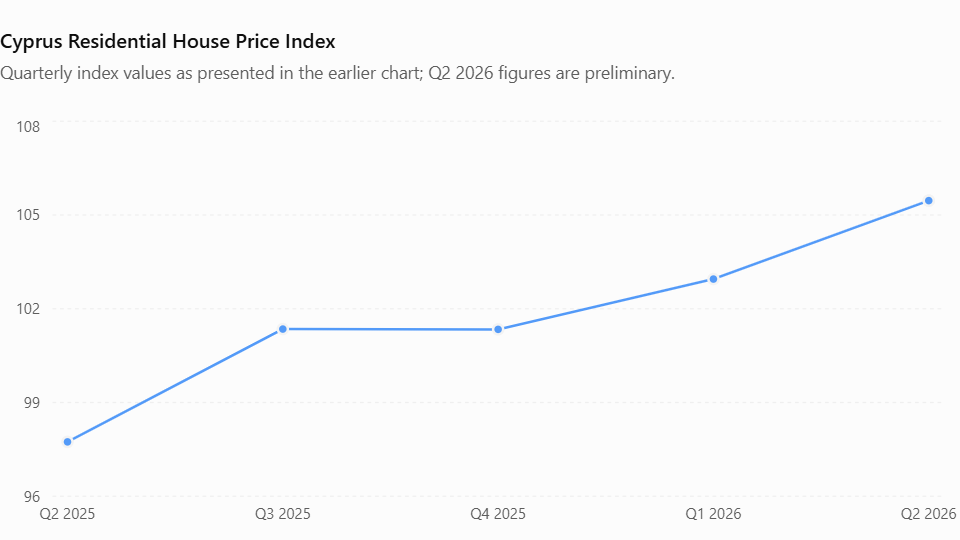
This data provides a useful snapshot of the market at a time when Cyprus continues to attract international attention as a destination for investment and relocation. However, national price movements do not necessarily reflect conditions in every district or property segment.
For international investors, these developments reinforce the importance of evaluating property acquisitions on their individual merits. Location, purchase price, construction quality, title documentation, expected rental performance, liquidity and future resale potential should all form part of a thorough assessment.
Although international wealth mobility can support investment activity and demand for property, broader market trends do not guarantee returns on any individual acquisition. Investors should consider both potential opportunities and the risks associated with changing prices, financing costs and market conditions.
Beyond Investment: Building a Long-Term Base in Cyprus
For many internationally mobile individuals and families, choosing a country involves more than selecting an investment destination. It can also mean establishing a business presence, securing suitable residence arrangements, planning for family members and identifying a place to live and work over the longer term.
Another significant development is Cyprus’s anticipated accession to the Schengen Area, with the government targeting full membership during 2027. In 2026, the European Commission assessed Cyprus’s technical preparedness, while the Cypriot government continued to express its objective of achieving accession during 2027 (European Commission, 2026; Cyprus Mail, 2026).
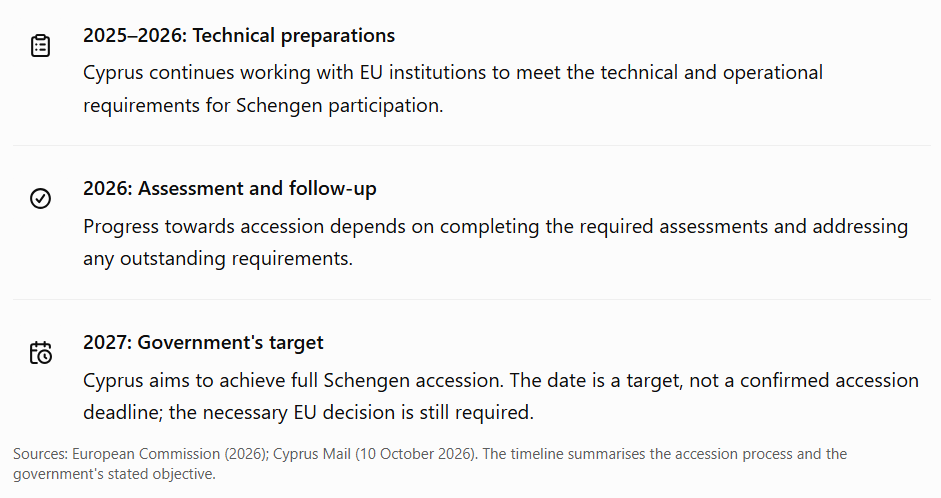
Although the final decision rests with the Council of the European Union and the necessary requirements must be fulfilled, accession would represent a further step in Cyprus’s European integration. It would facilitate travel within the Schengen Area by removing internal border controls involving Cyprus, subject to the applicable arrangements, and could further strengthen the island’s appeal to internationally mobile entrepreneurs, investors and families.
For non-EU nationals, the implications would depend on their residence status and the applicable rules. Schengen membership should not be interpreted as automatically granting EU-wide residence or work rights. Nevertheless, the prospect of accession adds another relevant consideration for individuals assessing Cyprus as a potential long-term base.
Beyond its prospective Schengen membership, Cyprus offers a combination of EU membership, international connectivity, professional services and Mediterranean living that can make it a compelling option for these objectives. Its position in the 2026 wealth mobility assessment reflects the importance of considering these factors together rather than viewing taxation or investment opportunities in isolation (Henley & Partners, 2026).
At the same time, decisions involving residence, taxation, property and international wealth structures require careful consideration of the applicable legal and regulatory requirements. A country’s overall attractiveness is only one part of the assessment; the benefits available to each individual depend on their specific circumstances and the rules in force.